Carryover cooking

Greetings Carnivores,

An old friend asked a good question the other day and it’s worthy of a few words of clarification.

It went something like this: “What are your recommendations as to timing for various meats, fish, poultry and their respective thicknesses?”

My answer is … I ALWAYS use a good, digital read thermometer but, the MOST IMPORTANT THING TO REMEMBER regarding the correct “doneness” is … whatever you’re cooking CONTINUES to cook after it’s been removed from the heat.

Residual cooking or, carryover cooking is a term that refers to the continuation of the cooking process AFTER the protein has been removed from the heat source. Think of it this way: regardless of the heat source (whether it’s hot air inside your oven or a hot surface such as your grill, skillet … whatever), your protein cooks from the outside in and, the inside cooks by induction. After you remove it from the heat, it will continue to cook … for up to 20 minutes, depending on how thick the piece of meat is that you’re cooking.

This speaks VOLUMES to the disappointment factor once you cut into your (supposedly) perfectly cooked steak, only to realize it’s “doneness” is well PAST the point you “thought” you had.

Once your meat has been removed from the heat, and it’s “resting” to reabsorb all those delicious juices … it’s STILL cooking. The process of bringing your protein up to the desired cooking temperature is NOT instant and as such, the process of bringing it back down is the same … GRADUAL. Therefore it’s only reasonable to assume (correctly) that the internal temperature of your beautiful steak (roast, chop … whatever) will actually continue to RISE after the heat has been removed.

Now, … there is some trial and error involved in getting it just right but, lets assume you enjoy your steak Medium Rare (and for me that’s anywhere from 127 degrees F to 130 degrees F … 128 is perfect for me) … I’m removing it from the heat and starting the resting process at around 125 F.

294
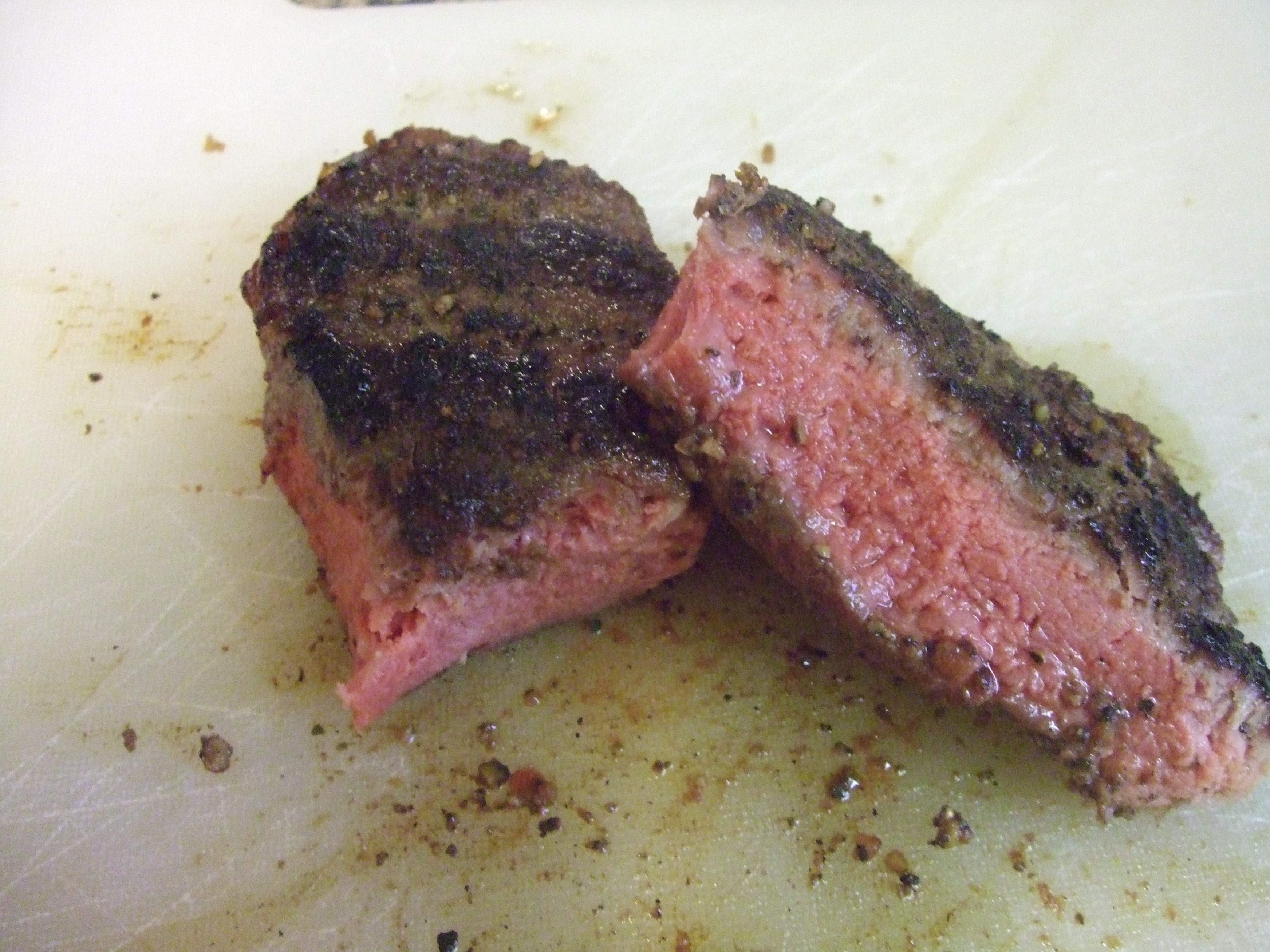
Ahhhh … the sweet spot
298
Look at the perfect, edge to edge colour and the beautiful char on the outside

If that’s too extreme for you … leave it a little longer but remember … if you’re using a REALLY hot grill, your window for nailing the perfect internal temperature is VERY small.

I wrote a post a while ago called The Beef Steak … reverse engineered … check it out here … you might find it interesting since you first, VERY slowly bring your steak up to the desired internal temperature, then you rest it.

Give it a try … you’ll never cook steak any other way again … trust me 🙂

In the meantime, please stay tuned and … don’t forget to click “follow Blog via email” (CarnivoreConfidential).

You’ll get an email notice every time I write something new … and, I PROMISE … you won’t get bombarded with spam. WordPress is very responsible. 🙂

Until next time Carnivores, stay hungry and as usual, please follow my posts on Twitter @DougieDee and like and share them on Facebook http://www.facebook.com/carnivoreconfidential

Responses

  1. auntiedoni Avatar

    Sound advice Doug. Could you tell the brand of digital thermometer you use? Mahalo, TIA.

    1. Carnivore Confidential Avatar

      Wow … ya got me Auntie with the “TIA” and, since I’m ‘pretty sure’ you weren’t referring to ‘Transient Ischemic Attack’ … I went ahead and googled the ‘Slang’ term TIA … geeze, I’m getting old I guess 🙂
      As far as my thermometer goes … here’s a link to one I have.
      http://www.oxo.com/p-557-digital-instant-read-thermometer.aspx
      I like it … but I need a new one.
      Since that post, my pooch got a hold of it … ya, it’s not so good anymore. 😦
      Great to hear from you Aunti oh and … A’ole pilikia
      🙂 🙂 🙂

      1. auntiedoni Avatar

        Maikai Doug, Maikai no au 😀

  2. Patrons of the Pit Avatar

    Indeed, a literate write-up on an oft overlooked subject in the meaty arts. I agree tho with the business of carry over cooking. It happens. I many times utilize this fact of life with pork shoulders, plunking them in a cooler for a couple of hours to rest and finish cooking there.

    I need a steak now…

    1. Carnivore Confidential Avatar

      Yes indeed … try reverse cooking it my smokie Brutha … Soooooooo good 🙂

  3. Gary Lum Avatar

    Thanks Doug. This is a fantastic explanation.

    1. Carnivore Confidential Avatar

      Very welcome Dr Gary … thx as usual for stopping by 🙂

  4. Conor Bofin Avatar

    Stefan, of Stefan Gourmet blog gave me a digital thermometer last year. It is a great friend when roasting meat or poultry. I cooked a big thick steak (3″ thick) recently and I took the meat out of the oven 7º before the desired temperature. It finished itself exactly. I was very pleased to have got it right.

    1. Carnivore Confidential Avatar

      Indeed … when you get it right, it’s a thing of beauty. 🙂
      Bringing your meat slowly back during the ‘resting’ stage is sort of like removing your foot from the gas, and very gently applying the brakes.
      Thanks for stopping by Conor … nice to hear from you 🙂

  5. thedeerslayerswife Avatar

    Dear CC, Your timing couldn’t have been more, uh, timely. I have a question about searing backstraps and tenderloins before placing them in the oven to “finish them off”. I always sear the venison/wild pork/elk/nilgai backstraps and/or tenderloins in my trusty cast iron skillet before sticking the whole thing in the oven for about 10 minutes. My question is “Do I need to remove the meat from the cast iron to let it rest on a cutting board? I’ve been reluctant to remove the meat from the skillet for fear of releasing the juices held in by the delicious seared crust.

    1. Carnivore Confidential Avatar

      YES !!! REMOVE TO A ‘NEUTRAL’ surface … but the key is to use a digital thermometer so that you can “play around” with what works for you, temp/doneness wise.
      Good luck DSW 🙂
      THX for dropping by 🙂

  6. Debbie Spivey Avatar

    Great advice, Doug. 🙂

  7. The Gourmet Gourmand Avatar

    Great suggestions.. and thanks for 128 degree tip- medium-rare is my favorite as well 🙂

    1. Carnivore Confidential Avatar

      Very welcome … thx for stopping by 🙂

  8. milkandbun Avatar

    Very useful tip -about the temperature! Thanks for sharing!

    1. Carnivore Confidential Avatar

      You’re very welcome … thx for stopping by 🙂

  9. Sous-vide, Surgery and a bunch of time on my hands … again. | Carnivore Confidential Avatar

    […] Think of it this way: let’s say you’re aiming for a nice medium rare beef steak (Rib eye for the sake of argument). The “window” you’re aiming for, for med-rare is (128-131 degrees F. for me) That “window” is extremely  hard to hit with conventional cooking methods because of inconsistencies in the cooking vessel, whether it’s a Grill, Oven or Pan, temperature fluctuations, and (click here)  carry-over cooking. […]

Leave a reply to Conor Bofin Cancel reply